AI Powered Predictive Maintenance for Equipment
Implement AI for predictive maintenance, reducing downtime and extending the lifespan of your business equipment.
Implement AI for predictive maintenance, reducing downtime and extending the lifespan of your business equipment.
AI Powered Predictive Maintenance for Equipment
Hey there, small business owners and entrepreneurs! Let's talk about something super important for keeping your operations running smoothly: your equipment. Whether you're running a manufacturing plant, a fleet of delivery vehicles, a bustling restaurant with complex kitchen machinery, or even just an office with critical IT infrastructure, equipment breakdowns can be a real nightmare. They lead to unexpected downtime, costly repairs, missed deadlines, and ultimately, unhappy customers and lost revenue. But what if you could see these problems coming before they even happen? That's where AI-powered predictive maintenance swoops in like a superhero for your business.
Gone are the days of reactive maintenance – fixing things only after they've broken down. And even scheduled preventive maintenance, while better, can still lead to unnecessary part replacements or missed issues that develop between checks. Predictive maintenance, especially when supercharged with artificial intelligence, takes a smarter approach. It uses data, lots of it, to predict when a piece of equipment is likely to fail, allowing you to perform maintenance exactly when it's needed, not too early and not too late. This isn't just about saving money; it's about optimizing your entire operation, extending the life of your valuable assets, and ensuring uninterrupted service for your customers.
Understanding AI Predictive Maintenance How It Works for Small Businesses
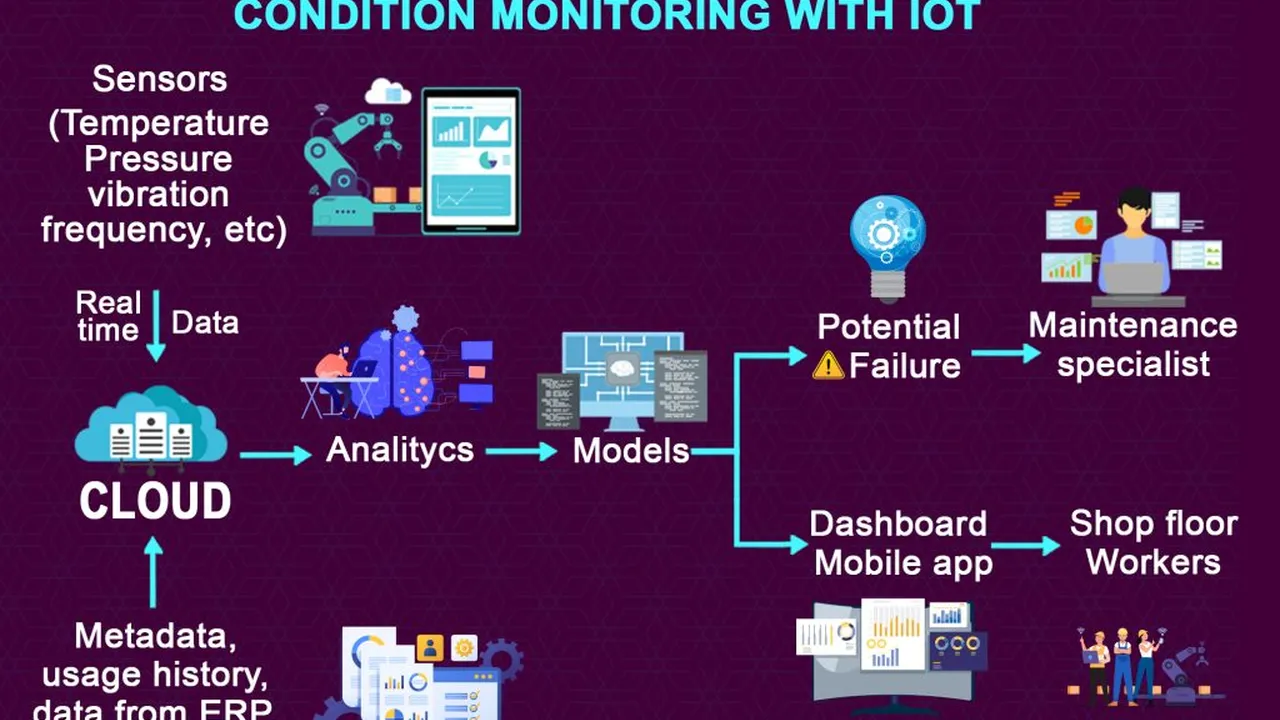
So, how does this magic happen? At its core, AI predictive maintenance involves collecting data from your equipment. This data can come from various sensors – think temperature, vibration, pressure, current, acoustic emissions, and even visual inspections. This raw data is then fed into AI algorithms, often machine learning models, which are trained to identify patterns and anomalies. These patterns might indicate normal operation, but more importantly, they can signal the early stages of a potential failure.
For example, a slight increase in vibration in a motor might be normal, but a consistent, escalating pattern of vibration, combined with a subtle rise in temperature, could be a strong indicator that a bearing is about to fail. A human might miss these subtle correlations, especially across vast amounts of data, but an AI system can spot them instantly. The AI learns from historical data – both healthy operation and past failures – to build a robust understanding of what 'normal' looks like and what deviations signify trouble. When the AI detects these warning signs, it can alert your team, allowing you to schedule maintenance proactively, order necessary parts, and avoid a catastrophic breakdown.
Key Benefits of AI Predictive Maintenance for Small Business Operations
Why should a small business invest in this technology? The benefits are pretty compelling:
- Reduced Downtime and Increased Uptime: This is probably the biggest win. By predicting failures, you can schedule maintenance during off-peak hours or planned shutdowns, minimizing disruptions to your production or service delivery.
- Lower Maintenance Costs: You're no longer replacing parts unnecessarily or waiting for expensive emergency repairs. Maintenance becomes more efficient and targeted.
- Extended Equipment Lifespan: Addressing minor issues before they become major problems helps preserve your equipment, extending its operational life and delaying costly replacements.
- Improved Safety: Equipment failures can be dangerous. Predictive maintenance helps prevent accidents by identifying potential hazards before they escalate.
- Optimized Resource Allocation: Your maintenance team can focus on critical tasks rather than routine checks or frantic emergency repairs.
- Better Inventory Management: Knowing when parts will be needed allows for just-in-time ordering, reducing the need for large, expensive spare parts inventories.
- Enhanced Customer Satisfaction: Fewer unexpected outages mean more reliable service or product delivery, leading to happier customers.
Choosing the Right AI Predictive Maintenance Tools for Your Business
Alright, so you're convinced. But where do you start? The market for AI predictive maintenance solutions is growing, and there are options suitable for various business sizes and industries. Here are a few types of solutions and some specific products to consider, along with their typical use cases and pricing models. Keep in mind that pricing for these enterprise-level solutions can vary widely based on the number of assets, data points, and specific features required, so these are general estimates.
1. Cloud-Based Predictive Maintenance Platforms for Diverse Industries
These platforms are often comprehensive, offering data ingestion, AI model training, anomaly detection, and visualization dashboards. They are highly scalable and can integrate with existing ERP or CMMS (Computerized Maintenance Management System) systems.
Product Recommendation: IBM Maximo Application Suite
- Description: IBM Maximo is a well-established enterprise asset management (EAM) system that has heavily integrated AI and IoT capabilities for predictive maintenance. It allows businesses to manage all types of assets, monitor their condition in real-time, and predict potential failures using AI. It's a robust solution for complex operations.
- Use Case: Ideal for manufacturing, utilities, transportation, and facilities management with a large number of critical assets. It helps in optimizing asset performance, reducing operational costs, and ensuring regulatory compliance.
- Key Features: Asset lifecycle management, work order management, inventory management, AI-powered anomaly detection, prescriptive maintenance recommendations, mobile access, integration with various data sources.
- Comparison: Maximo is known for its depth and breadth of features, making it suitable for larger small businesses or those with complex asset portfolios. It offers more customization and integration options compared to simpler, off-the-shelf solutions.
- Estimated Pricing: Typically subscription-based, starting from several hundred to thousands of dollars per user per month, or based on asset count. It's a significant investment but offers extensive capabilities.
Product Recommendation: PTC ThingWorx
- Description: ThingWorx is an industrial IoT (IIoT) platform that enables businesses to connect, monitor, and manage industrial assets. Its predictive analytics capabilities leverage machine learning to identify patterns and predict failures, providing actionable insights.
- Use Case: Excellent for discrete manufacturing, process industries, and smart product development. It helps companies build custom IIoT applications for predictive maintenance, remote monitoring, and operational efficiency.
- Key Features: IoT connectivity, data aggregation, real-time analytics, machine learning for predictive modeling, augmented reality (AR) for maintenance guidance, customizable dashboards.
- Comparison: ThingWorx is more of a platform for building IIoT solutions, offering flexibility for businesses to tailor their predictive maintenance applications. It might require more technical expertise to set up compared to a more out-of-the-box EAM system like Maximo, but offers greater customization.
- Estimated Pricing: Project-based or subscription, often requiring a custom quote. Can range from thousands to tens of thousands annually depending on scale and features.
2. Specialized Sensor-Based Predictive Maintenance Solutions for Specific Equipment
These solutions often come with their own hardware (sensors) and a dedicated software platform, making them easier to deploy for specific types of machinery.
Product Recommendation: Augury Machine Health Solutions
- Description: Augury specializes in machine health monitoring using advanced vibration and acoustic sensors combined with AI. Their system continuously monitors critical rotating equipment, detects anomalies, and provides detailed diagnostics and prognostics.
- Use Case: Perfect for small businesses in manufacturing, food & beverage, and other industries relying heavily on motors, pumps, fans, and other rotating machinery. It helps prevent unexpected failures in production lines.
- Key Features: Wireless vibration and temperature sensors, AI-powered diagnostics, remote monitoring by expert analysts, detailed reports, integration with CMMS.
- Comparison: Augury offers a highly specialized and accurate solution for rotating equipment. It's less about a broad EAM and more about deep insights into specific machine health, often with human expert oversight complementing the AI.
- Estimated Pricing: Typically a subscription model based on the number of machines monitored, often starting in the low thousands per year for a few critical assets.
Product Recommendation: Senseye PdM
- Description: Senseye PdM (now part of Siemens) is a software-only solution that connects to existing industrial data sources (SCADA, historians, PLCs) and uses AI to predict machine failures. It focuses on ease of use and rapid deployment.
- Use Case: Suitable for small to medium-sized manufacturers who already have some level of data collection from their machinery and want to add predictive capabilities without extensive new hardware.
- Key Features: Connects to existing data, AI-driven anomaly detection, remaining useful life (RUL) predictions, intuitive dashboards, maintenance scheduling integration.
- Comparison: Senseye is known for its user-friendly interface and ability to integrate with existing data infrastructure, potentially reducing initial hardware costs. It's a strong contender for businesses looking for a software-centric approach.
- Estimated Pricing: Subscription-based, often priced per asset or per data point, requiring a custom quote.
3. AI-Powered Computer Vision for Predictive Maintenance and Quality Control
While not purely predictive maintenance in the traditional sense, AI computer vision can play a crucial role in identifying wear and tear or quality issues that precede equipment failure.
Product Recommendation: Landing AI LandingLens
- Description: LandingLens is an AI platform for visual inspection. While primarily used for quality control, it can be adapted to monitor equipment for visible signs of wear, cracks, leaks, or other anomalies that could lead to failure.
- Use Case: Manufacturing lines for detecting defects, monitoring the condition of surfaces, or identifying early signs of degradation in components that are visually accessible.
- Key Features: No-code AI development for computer vision, image and video analysis, anomaly detection, defect classification, easy deployment to edge devices.
- Comparison: This is a different angle. Instead of sensor data, it uses cameras. It's excellent for visual inspections that are currently done manually and prone to human error or fatigue. It complements traditional sensor-based PdM.
- Estimated Pricing: Subscription-based, often tiered by usage (e.g., number of images processed, models deployed). Can range from hundreds to thousands per month.
Implementing AI Predictive Maintenance Practical Steps for Small Businesses
Ready to dive in? Here’s a simplified roadmap for getting started with AI predictive maintenance:
- Identify Critical Assets: Don't try to monitor everything at once. Start with the equipment whose failure would have the biggest impact on your business.
- Assess Data Availability: Do you already have sensors on your equipment? Can you easily add them? What kind of data are you currently collecting?
- Define Your Goals: What do you want to achieve? Reduce downtime by X%? Extend asset life by Y years? Lower maintenance costs by Z?
- Choose the Right Solution: Based on your critical assets, data availability, and goals, select a solution that fits your budget and technical capabilities. Don't be afraid to start small.
- Pilot Project: Implement the solution on a small scale first. Monitor a few critical machines, gather data, and validate the AI's predictions.
- Integrate and Scale: Once the pilot is successful, integrate the predictive maintenance system with your existing maintenance workflows and gradually expand to more assets.
- Train Your Team: Ensure your maintenance staff understands how to use the new system, interpret the alerts, and act on the insights provided by the AI.
Challenges and Considerations for Small Business AI Adoption
While the benefits are clear, it's important to be aware of potential hurdles:
- Initial Investment: There's an upfront cost for sensors, software, and implementation. However, the ROI can be significant in the long run.
- Data Quality and Quantity: AI thrives on good data. If your equipment doesn't generate enough relevant data, or if the data is messy, the AI's predictions won't be accurate.
- Technical Expertise: While many solutions are becoming more user-friendly, some level of technical understanding (or access to it) is often required for setup and ongoing management.
- Integration Complexity: Integrating new systems with existing legacy equipment or software can sometimes be challenging.
- Change Management: Your team needs to be on board with the new way of working. Training and clear communication are key.
The Future of Equipment Management with AI
AI-powered predictive maintenance isn't just a trend; it's becoming a standard for efficient and resilient operations. For small businesses, embracing this technology means moving from a reactive, costly approach to a proactive, optimized one. It means your equipment works harder, lasts longer, and your business runs smoother, giving you a significant competitive edge. So, take a look at your most critical assets and start exploring how AI can help you keep them in peak condition. Your bottom line (and your peace of mind) will thank you for it!
:max_bytes(150000):strip_icc()/277019-baked-pork-chops-with-cream-of-mushroom-soup-DDMFS-beauty-4x3-BG-7505-5762b731cf30447d9cbbbbbf387beafa.jpg)